Why 52 Women?

It's not all about lipo, hair color and botox...

Monday, January 31, 2011

Meet Caron ("Ca-rown")

Another mucky gray sky.

 Not even 30 degrees outside. 

Felt sorry for myself. 

Missed my husband. My kids. 


To get out of my funk, hooked a leash on George and headed out the door.

Took my usual route, past Trader Joe's market, a favorite spot for homeless people to sell newspapers.

 Caron (pronounced Ca-rown) stood next to the telephone pole at the crosswalk.

"How ya doing?" 

"Great. Like your dog." 

"Thanks."

Took a few steps - told MYSELF, "Don't get stuck talking. It's too cold." 

Then turned around.

"How's business?"

"O.K. Yesterday, not so good. Hopefully, today will be better."

Caron explained how she ended up selling these newspapers.
Caron lost her job at a fast-food restaurant. 
Then, lost her apartment. 
Now lives in a hotel.
 Pays $44 per night because she hates sleeping at the women's mission.
 "They make you pack up and be gone by 5 a.m. each morning with all your stuff." 

"You looking for a regular job?"

"Yes, but if I go job hunting, I don't make any money selling."  

"Do you have kids?"

"They're all grown. The youngest is in the pen."

"For what?"

"Drugs."

"You look so young to have someone in prison." 
(I know, I say the dumbest things sometimes.) 

"I'm 51."

 "Ah, we're the same age."

Caron's red lipstick outlined her yellow teeth.

"Have a great day. I hope you sell lots of papers."

"Thanks, you have a great day too."
 "Bye George."

An hour later, stopped to pay $10 for her $1 newspaper, but Caron was gone. 

Haven't seen her since.

Hope that means she found full-time work. 

Want to thank her for shining some light on what's important in life.

Wednesday, December 8, 2010

Meet Ed

I never planned to feature a man.

Then I met Ed. Hours after we went our separate ways, I realized this total stranger had left such an imprint on my life, I had to share his story.

I work at a home furnishings store and last week, Ed and his wife Sue came in to buy a throw. Sue moved extremely slow as if she just got out of surgery and every step was pure agony. Ed patiently trailed behind as I guided Sue to the display tables. He stood nearby while she deliberated which color was best and whether she should even buy it.

"How long have you two been married?" I asked attempting to fill the time.

Sue smiled, but didn't answer. Instead, she looked at Ed.

"Fifty nine years," he said.

"Wow, what's your secret?"

I noticed Sue's vibrant blue eyes and silver white bob. Just a hint of mascara coated her lashes and she wore a soft pink lipstick. She had a chunky Grandma-type figure (short with rounded edges) and wore a white sweater set with tan high waisted pants and spotless white leather sneakers.

Again, Sue smiled at Ed, a lean silver haired Grandpa-type in a collared shirt, khakis and a navy canvas zip-up jacket. He looked down, smiled, then turned toward me as if I asked directions and he was trying to figure out the most direct route.

"A lot of hard work and a lot of prayin'," He said, adding, "Sue's had health issues."

Together, they ran down her ailments. Around 20 years ago, Sue slipped on black ice, fell down a flight of stairs and laid outside with a crushed ankle and her leg broke in four places.

"My hair nearly froze off," she said.

A few years later, Sue had a brain tumor and then surgery to remove it, followed by a heart attack and  surgery for a pacemaker. Most recently, she had a stroke that left her paralyzed on one side.

"That's been the hardest," Sue said slowly, explaining how she's had to learn everything all over again.

I looked over at Ed who was watching his wife. His kind eyes told what he never said, how he's learned to accept the changes, her limitations and find joy in the added responsibilities.

I'm a sucker for a good love story, but in an attempt to not lose control, I quickly changed the subject.

"How was your Thanksgiving?"

"Great," Sue said.

"We had 18 people over," Ed added.

"Who cooked?" I blurted out before out before I could can catch myself. "I mean, did everyone bring something?"

Sue just smiled and looked at Ed.

"I did the cooking," Ed said. "I learned how in the army."

Ed made chicken, stuffing, potatoes, macaroni and cheese, broccoli, sweet potatoes, turnip greens and at least five other dishes, along with a coconut cake.

"The only thing I can't make is biscuits. The dough sticks to my fingers," he said, mimicking how he wipes the dough off.

Hours later, I recognized the gift Ed left behind.

He reminded me if you're married or committed to someone, the secret to aging gracefully together is three-fold. Savor the good. Accept the "whoa-I-never-thought-I'd-be-doing-this" parts. And third, find joy in the every day things, the simple little stitches that bind your souls.

Tuesday, November 30, 2010

Meet Laura


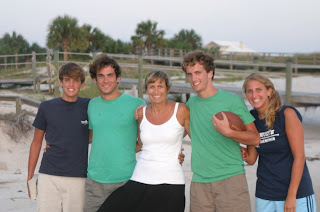
Laura, center, with her children (L to R) Ted, Will, Seth and Betsy

     Laura looks healthier than most people her age, yet she lives with a chronic illness that requires her to visit the local hospital once a month for the rest of her life. If she didn't, she would die. 
     You would never know it looking at Laura or even spending time with her because Laura chooses to not let her illness define her. Along the way, she's also learned to trust pain and not be afraid of it. 
     In August 2006, Will, one of Laura’s four children, was home from college and noticed her feet were swollen. Laura, an active Realtor, professional school fundraiser, and wife of a minister, stopped long enough to check her blood pressure. The reading was normal.
     At 49-years old, Laura didn’t think much about it. For years, she’d taught swim lessons and coached teams. She was an avid walker and took yoga and weight classes. She knew little aches and pains, even swelling, sometimes come with daily exercise. Laura also knew she was more tired than usual, but she attributed it to having two children still at home and in high school. Betsy, her only daughter, was in her senior year.
     However, two weeks later when her symptoms didn’t go away, she consulted a doctor. Both her white and red blood counts were dangerously low. Her red count should fall between 39 and 45.
     “Mine was 26. You start losing brain cells at around 22 because you don’t have any oxygen. You can go into cardiac arrest,” she explained.
     Her white count should fall between 5,000 and 8,000. “Mine was 2,000,” she added.
     The next day, Laura and her husband drove to a specialist. On the way, Laura started to have a heart attack. Her heart was pumping too fast. They made it to the hospital where she was admitted for testing and days of poking and prodding.
Laura with Kenny, her husband of 29 years. "Getting sick was the best thing for our marriage," Laura said. "Kenny was just a rock star - all the shots, all the things he did - twice we took a break for a week from all the doctor visits and treatments. One week, he took me to a movie every day. He kept our head on for us. He kept things stable and calm."
     Two weeks later without a diagnosis, she was sent home. Kenny learned how to to give her shots every day. Nothing made her better. She felt like she had the worse case of mono. Everything ached. Just walking the 20 feet from the house to the car zapped her energy.
     Over the next eight months while doctors tried to diagnose her symptoms, Laura was admitted into the hospital 14 times, endured 14 blood transfusions (one every three weeks) four bone marrow aspirations (“craaaazy” painful, she said), received three rounds of chemo, participated in numerous experimental treatments, and had her spleen removed.
     Not surprisingly if you know Laura, she was never alone. Besides Kenny and the children, throughout the journey, she’d wake up and find hospital staff – doctors, nurses, and technicians – praying beside her bed.
     In the end, Laura discovered not only had she been exposed to tuberculosis while living overseas but worse, she was born with a compromised immune system.
     “I don’t have two components in my immune system,” she said.
     If left untreated, Laura could have died. Now once a month, she gets up early and drives herself to the hospital. For 10 hours straight, she sits quietly in a chair surrounded by other patients, some, just days from death, while an IV drips her missing blood products into her vein. Then she drives herself home and spends the next 12 hours sick to her stomach.
     This procedure has become part of Laura’s life but it doesn’t define her. She trusts God’s plan although she continues to challenge her body.
     Nearly two years ago, after getting her doctor’s approval, Laura and I trained for our first half marathon together. Each week, we’d text each other to confirm our walking times before meeting. One day, she didn’t respond. 
     “Where were you yesterday?” I asked as we race walked our 8-mile course along the river and through old town, past mothers pushing babies in carriages and elderly couples strolling in silence holding hands.
     “Oh sorry, it was my hospital day,” Laura said.

Wednesday, November 10, 2010

Meet Safka


I heard Safka before I saw her on the side of Buchanan Street, one of Glasgow's charming pedestrian thoroughfares. It was a typical miserably cold November day, the kind that makes both locals and tourists walk quicker and talk less, anything to stay warm and dry.

Standing in the rain, Safka, a plump elderly woman with a babushka tied under her rolled chin, played her accordion to the moving audience peering out from under their hoods and umbrellas.  Her gloved thick fingers sailed over the keyboard as she pumped the bellows and swayed to her music. Safka didn't skip a beat as she thanked the occasional passersby who dropped tokens in her bag.

And she also didn't move under the nearby building's overhang.

I left to eat lunch. An hour later, Safka was still standing there in the same spot, playing the same song. I dropped a few coins in her bag and asked some questions. Safka is 77 years old, Romanian and beyond that, couldn't or wouldn't speak English.

Then she smiled and thanked me as if I was a close friend who came to watch her perform. I thought, I should be thanking her for playing, albeit the same tune, like the sun was shining on Buchanan.

Tuesday, October 19, 2010

Meet Valerie

Sometimes people come into your life in the most bizarre places, and you don't realize they'll leave such a lasting impression until after you part ways.

A few weeks ago, I was flying home from New York and had to change planes in Charlotte.  On my way to my next gate, I dashed into the ladies' room for a quick pit stop in Terminal C. It was early - maybe 7:30 a.m. - and I'd been up for hours. That's when I heard Valerie.


There I was relieving my bladder, minding my own business in my own little stall when I first heard her singing. I listened while I washed my hands and walked out. Maybe it was the lack of sleep, but at first, I found her singing annoying. Then a funny thing happened on my way to my next gate: Valerie's little "diddy" got stuck in my brain. A week went by and it was still there. Another week - still there. Finally, it hit me.

Valerie has taken a menial, rather depressing job and made it enjoyable. I know nothing about her - how old she is, how long she's been wiping down toilet seats and sink counters, picking up women's trash and going home each day smelling like a public bathroom. None of that matters.

Valerie reminded me to find the joy and humor in life. Next time I fly through Charlotte, I'll be sure to thank her.